

Let me tell you something that might surprise you. Most of my clients don’t hire me as a virtual assistant.
They hire me as their Operations Manager.
I know. It’s a mouthful, and honestly “VA” is the label the internet gave me, so I use it. But after 10 years of working with founders, I’ve learned that the title on the tin matters a lot less than what’s actually happening behind the scenes. And what happens behind the scenes with me is very different from what most people expect when they type “virtual assistant” into Google.
So let’s talk about it. Honestly.
What does a virtual assistant usually do?
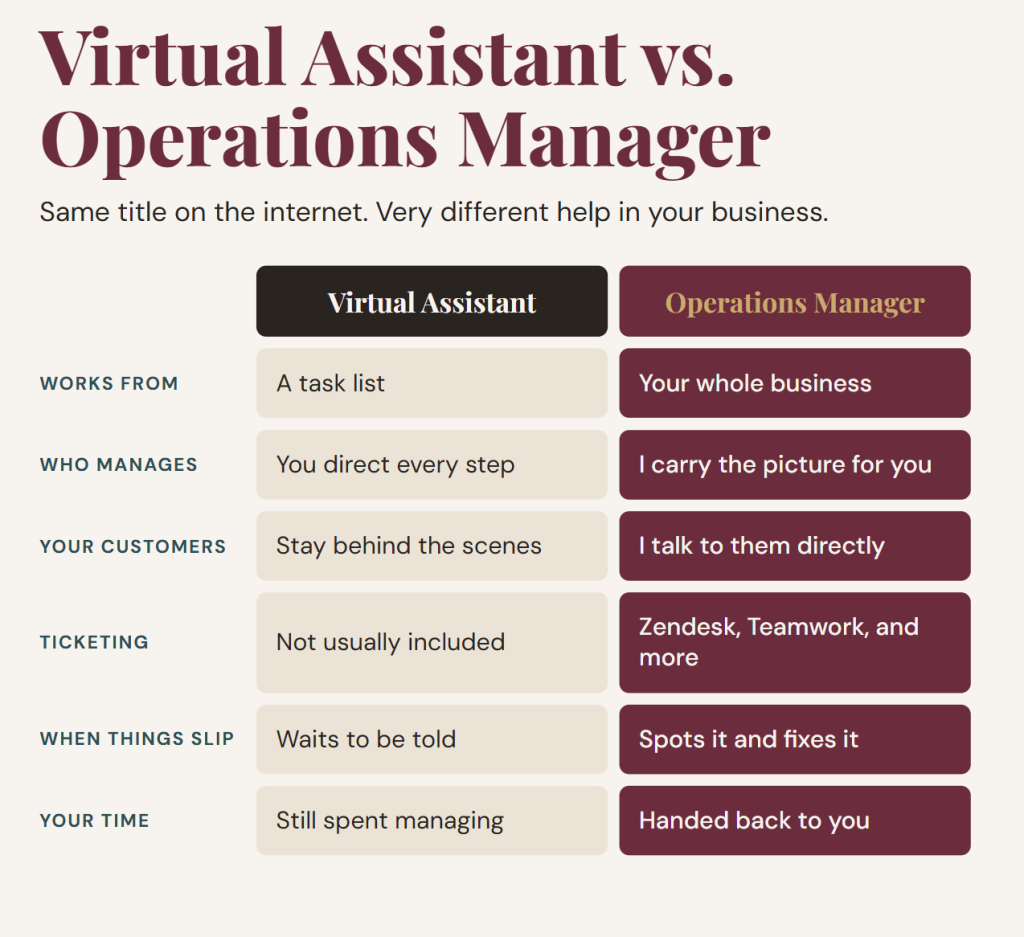
A traditional VA takes tasks off your plate. You hand over a list, they work through it. Inbox cleanup, calendar invites, data entry, booking a flight. That is real, valuable help, and if that’s all you need, a VA is a great fit.
But there’s a catch. You still have to be the manager. You decide what needs to happen, you explain it, you check that it got done, and you carry the whole picture in your head. The VA is an extra pair of hands. You’re still the brain.
What does an operations manager do differently?
An Operations Manager carries the picture for you.
When I step into a business, I’m not waiting for a task list. I’m learning how your business actually runs, finding what’s slipping, and fixing it. I’m part of your team, not a vendor you email once a week.
Here’s what that looks like day to day for my clients:
- Bookings and scheduling. I manage your calendar and your clients’ appointments, and I keep everything moving without anyone playing email tag.
- Invoicing and billing. I send invoices, follow up on payments, and keep the money side tidy so you’re never chasing anyone.
- Customer support and ticketing. I work inside tools like Zendesk and Teamwork, answering your customers, resolving issues, and escalating only what truly needs you.
- Event management. From planning to logistics to follow up, I make sure nothing falls through the cracks.
- Marketing support. I help keep your content, emails, and promotions consistent and on brand.
- Project management. I build the systems (Monday.com, Asana, Trello, Notion, whatever fits you) so your team always knows what’s happening and who owns it.
Notice the pattern? None of that is “take this one thing off my plate.” It’s “run this part of my business so I can focus on the part only I can do.”
I work with your clients directly
This is the biggest difference, and the one I’m proudest of.
I’m customer facing. Your clients talk to me. They get answers from someone who knows your business, your tone, and your standards. I’m the one following up on that quote, answering that question at 8am, and making sure your customer feels taken care of.
That takes trust. My clients trust me with their financials and their client communication, and I take that seriously. I show up like an extension of your team, because I am one.
A real example
One of my clients is a web development and support company. They originally hired me for one job: project manage their client tickets. Keep things organized, keep things moving.
By the end of week one, I was pulling the tickets I could handle myself and just doing the work. Not managing it, doing it. They were shocked, and honestly thrilled. They’d hired a project manager and gotten a project manager who also solved problems.
That’s the difference. I don’t wait to be told what to do. I look for what needs doing.
Operations manager vs cheap overseas virtual assistant: let’s be honest
I’m going to say something that some people won’t love, but I think you deserve the honest version.
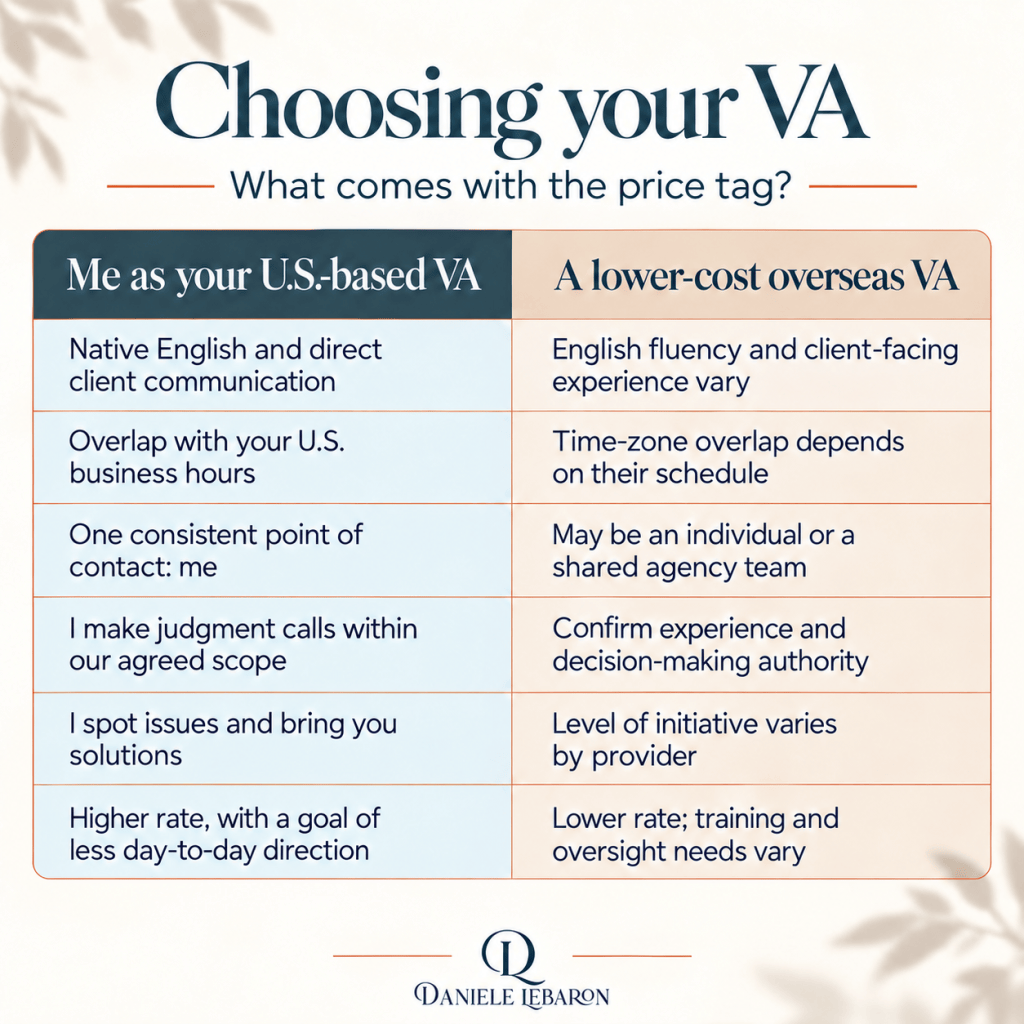
I cost more than a cheap overseas VA. And I’m worth it. Here’s why, and I’m saying this with respect for every VA out there doing good work.
A low cost offshore VA is usually built for task completion. That’s the model. You give clear instructions, you get the task back. It can work beautifully for repetitive, well defined jobs.
But when you need someone who talks to your customers, represents your brand, handles payments, and makes judgment calls on the spot, the model changes. Here’s what you’re really paying for with me:
- Native English and time zone overlap. I work in your business hours, in your language, with your customers. No lost messages, no misread tone, no waiting overnight for an answer.
- Judgment, not just execution. If a client is upset, I know how to handle it before you ever hear about it. If something looks off on an invoice, I catch it.
- Accountability. I’m not one of fifty VAs on a rotating team. You get me, every time, and I’m responsible for the outcome.
- Proactivity. Cheap VAs wait for instructions. I bring you solutions.
- Less of your time. This is the big one. A cheaper hire that needs constant direction costs you hours every week. My goal is to cost you almost none.
The cheapest option isn’t always the least expensive one. If you’re spending your evenings correcting work, re explaining things, or apologizing to a customer, the savings disappeared a while ago.
Is an operations manager right for you?
You might be ready for an Operations Manager instead of a VA if:
- You’re talented at what you do but you’re not the “systems person”
- Customer emails, tickets, or quotes keep sitting too long
- You’ve tried a VA before and still felt like you were doing all the managing
- Your business is growing and things are starting to slip
- You want someone who thinks about the business with you, not just for it
If that sounds familiar, you’re not behind and you’re not failing. You’ve simply outgrown doing it alone. I’m the last puzzle piece for a lot of founders, and it’s honestly my favorite part of this work.
What does working with me cost?
My Executive Operations plan starts at $1,500 a month, with a 6 month minimum. That’s a fraction of what a full time operations manager would cost you in salary, benefits, and taxes, and you get someone with 10 years of experience who’s already worked across 15 plus industries and 30 plus tools.
If you’re not sure you need that level yet, my Virtual Assistant Plan starts at $600 a month, and we can always grow into more as you’re ready. My clients stay, on average, over two years, and 100% of them expand their scope with me. Not because I push, but because once you feel what it’s like to have someone truly run things with you, you don’t want to go back.
Real Questions, Honest Answers
What’s the difference between an operations manager and a virtual assistant?
A virtual assistant completes tasks you assign. A virtual operations manager owns an entire area of your business, finds problems, builds systems, and works with your team and customers directly.
Can an operations manager be remote?
Absolutely. I’ve been remote first since 2016, and I work inside whatever tools your team already uses.
Do I need a full time operations manager?
Not always. Many small businesses are better served by a fractional operations manager who delivers the same results for a fraction of the cost.
Will you really talk to my customers?
Yes, and that’s the point. I learn your voice and your standards first, so your customers feel like they’re talking to your team, because they are.
Ready to talk?
If you’ve been wondering whether you need a VA or something bigger, let’s figure it out together. No pressure, no sales pitch, just an honest conversation about what’s slipping and what could change.

