

One of the first questions I get from founders who are thinking about hiring a virtual assistant is some version of “okay but what does this actually cost?” And honestly, I get it. Most VA agencies make you jump through three hoops and sit through a sales call before they’ll tell you anything about pricing. I’ve never understood that approach.
So here’s the straight answer, along with some context to help you figure out what you’re actually comparing when you shop around.
How the VA industry typically prices its services
There are two main pricing models you’ll run into when you start researching virtual assistant support.
Hourly pricing is the most common. Rates typically range from around $25 an hour on the low end for offshore or entry level support, up to $75 or more an hour for experienced US based VAs at larger agencies. Some agencies bundle hours into monthly packages. Others bill you down to the minute. Either way, the meter is always running, which makes it hard to budget predictably.
Monthly retainers are what agencies like mine offer. You pay a flat rate for a defined scope of work each month. No surprises, no watching the clock, no awkward conversations about whether that 20 minute call counts as billable time.
What Danielle LeBaron & Co. actually charges
I publish my pricing openly because I think you deserve to know what you’re getting into before you ever talk to me.
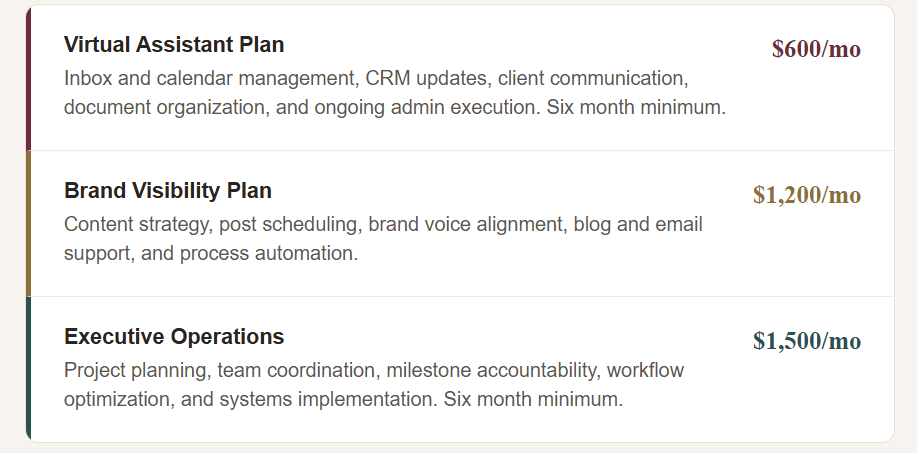
I also offer one time project engagements starting at $250 for things like marketing asset development, SOP documentation, operations audits, and CRM reorganization.
Why flat rate retainers are usually the better deal
Here’s the math that most people don’t think through. If you’re working with an hourly VA at $45 an hour and you need 15 hours of support a month, that’s $675 before any overages. Add a busier month and suddenly you’re at $900 or more.
A flat rate retainer means you know exactly what you’re spending. You can plan around it. And a good VA in a retainer relationship isn’t watching the clock either, she’s actually invested in your business running well.
What you’re really buying is time back
Holly Pflederer, Owner of Washington Self Storage, put it better than I ever could:
“Danielle has been a huge asset to our business. She has increased our monthly receivables, is customer service oriented and handles small and large projects with ease. She is extremely organized and provides new ideas to make our business more efficient. We love working with Danielle — she’s truly the best!”
Holly Pflederer, Owner, Washington Self Storage
Holly isn’t paying me to complete tasks. She’s paying me to make her business run better. That’s the difference between a VA who shows up and one who actually moves the needle.
When founders ask me whether hiring a VA is worth the cost, I always ask them the same thing back: how much is your time worth per hour? If you’re spending ten or more hours a week on admin work that someone else could handle, the math usually sorts itself out pretty quickly.
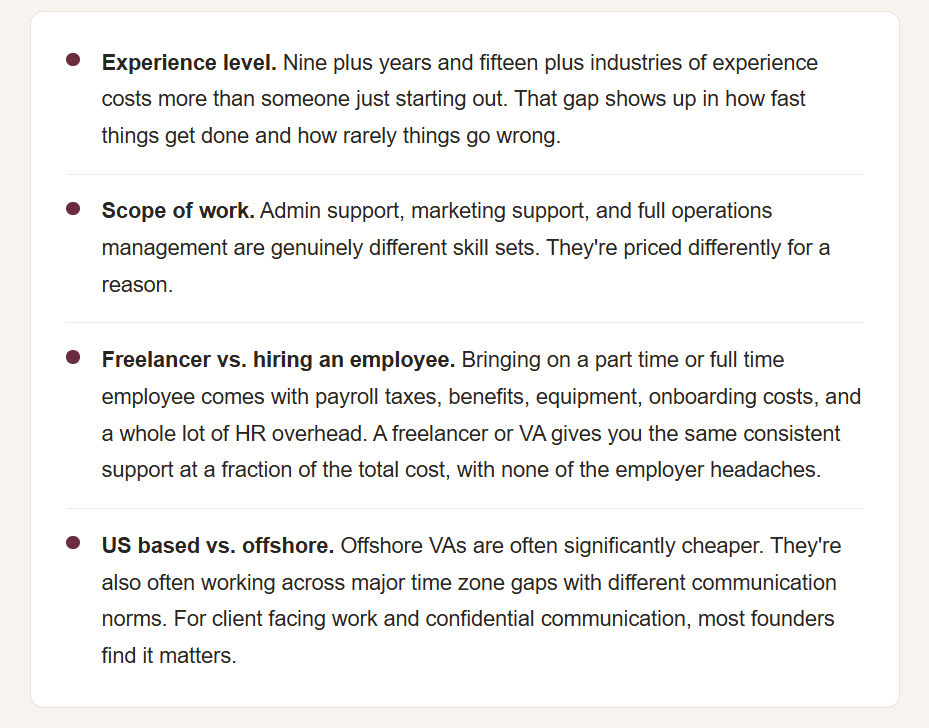
What affects the price
A few things that typically change what you’ll pay anywhere you look:About
The question worth asking yourself
Before you decide what you can afford to spend on a VA, ask what it’s currently costing you not to have one. Missed follow ups, delayed projects, an inbox that never hits zero, work that only gets done when you have energy left over at 9pm. That has a cost too. It’s just harder to see on a spreadsheet.
If you’re ready to talk through what support would actually look like for your business, I’d love to have that conversation. No pressure, no pitch, just an honest look at where you are and what might help.